

Cannabis Lab Test Results: What They Tell You (And What They Don't)
Cannabis lab test results tell you one thing well: the chemistry of a sample, measured by a third party. They report how much THC and CBD the flower holds, usually the terpene content, and who ran the numbers. They do not tell you how the flower will feel, how it was grown, or whether it will smoke clean. Reading a cannabis lab test is mostly learning where the useful part of the page ends.
Most growers meet their first report after they have already bought flower off the number on the label. Then they open a Certificate of Analysis and find two different THC figures, a column of acronyms, and no obvious answer to the only question they had. Here is how to read the page, and how to spot where it stops being an answer.
What a Certificate of Analysis is
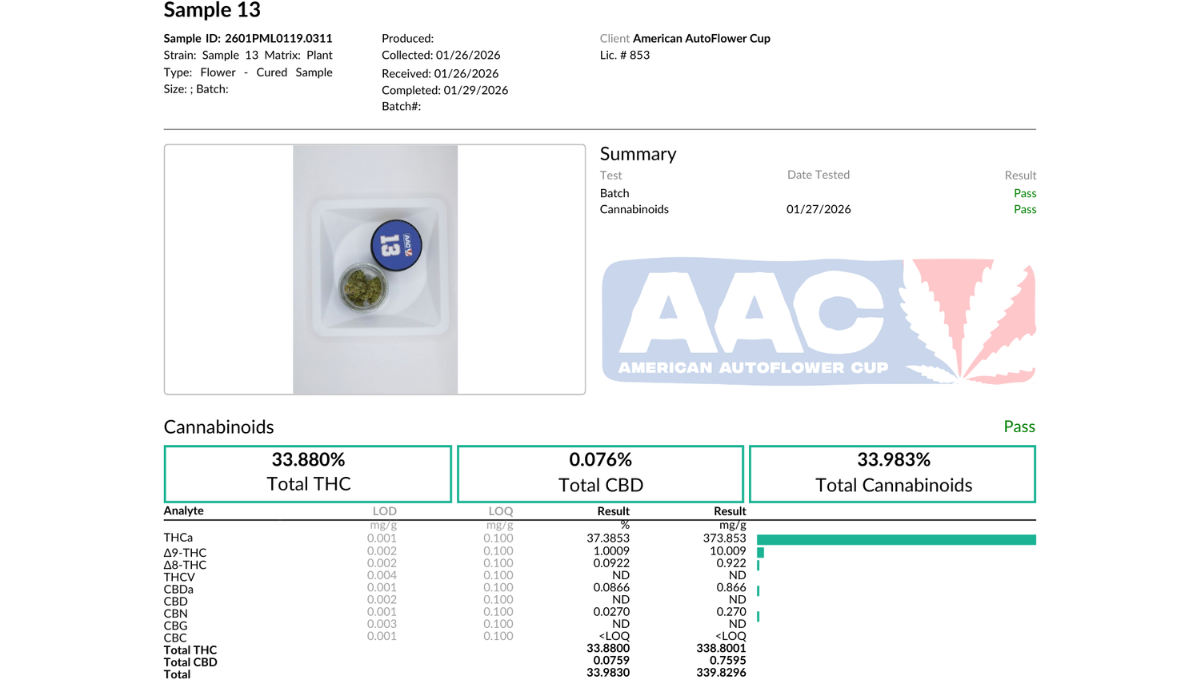
A lab test, usually called a Certificate of Analysis or COA, is an independent lab measuring what is in a sample of flower. A grower or breeder sends in buds, and the lab reports the cannabinoids, often the terpenes, and, in a regulated retail setting, a separate safety panel for things like pesticides and mold.
The word that carries the whole document is independent. A figure printed on a seed pack is a claim made by the people selling the seeds. A lab figure is a measurement taken by people with no stake in it. That is the entire reason a competition like the American Autoflower Cup sends every entry to a lab instead of trusting what each breeder says about their own strain.
THCA vs Total THC
A report shows two THC lines, THCA and THC, and the gap between them trips up most readers. Fresh flower holds almost all of its THC as THCA, the raw form that does nothing until heat converts it, so the figure you want is Total THC, which accounts for that conversion. A pack that quotes the big raw THCA number instead is rounding its potency up by a few points.
For the purpose of reading a COA, the rule is short: trust Total THC, not the raw acid figure and not the number on the label. The exact conversion, and why a tested 24% can beat an advertised 30%, is worked through in are autoflowers as strong as photoperiods.
Reading the rest of the panel
Below the headline numbers sit the minor cannabinoids: CBD, CBG, CBN, and a few others. On a standard recreational strain, most of these read as a trace, and that is normal. On a CBD autoflower, the CBD line is the one doing the work, so it runs high while Total THC stays low.
CBN is the one worth a glance. It tends to climb as flower ages or sits in bad storage, so a high CBN reading on something sold as fresh is a small warning sign. Many retail reports also list a terpene profile, the aromatic oils behind the smell, though a cannabinoid-only report like the cup's leaves it off. A total above 2% usually means a loud, flavorful jar.
How to read each line
| What you see | What it means | What to do with it |
|---|---|---|
| THCA | The raw, inactive acid form, where most of the flower's THC starts | Don't read it as the potency on its own |
| THC | The active form already present before any heat, usually small | Note it, then fold it into Total THC |
| Total THC | The figure that reflects what you'll feel, once the raw THCA converts under heat | Trust this, not the raw THCA or the label |
| CBD / CBDA | The calming cannabinoid; high only on CBD strains | Low on a THC strain is expected; high on a CBD one |
| CBG, CBN | Minor cannabinoids; CBN rises in old or badly kept flower | A high CBN hints the flower is aging |
| Lab name and date | Who ran the test, and when | Trust an independent lab over an in-house seller figure |
What a lab test does not tell you
A COA measures chemistry, not quality, and the two often diverge more than the numbers suggest.
- It does not tell you how strong the high will feel. Total THC sets a ceiling, but terpenes and the other cannabinoids shape the experience, which is why a tested 22% can hit harder than a tested 26%.
- It does not tell you how the flower was grown or cured. A bud can post a big number and still taste flat and smoke harsh if it was dried badly. No lab figure captures that.
- It does not tell you how honest the sample was. A number is only as good as the bud that went in. One hand-picked top cola can test higher than the jar you take home, so a single figure with no context deserves some caution.
And a potency reading is not a safety clearance. Cannabinoid numbers and the contaminant screen are separate tests, and one passing says nothing about the other.
How the cup uses the number
A lab result is why the cup's numbers mean something, and also why placings are never decided on the number alone. At the American Autoflower Cup the lab reading decides only the highest-THC category; the overall placings go to a panel that smokes each strain blind, so a flower cannot win on a big figure if it smokes poorly.
The numbers that come out are honest ones. The 2026 field averaged around 26% Total THC, and the ten strongest autoflowers of 2026 all cleared 31%, the strongest reaching 33.88%. Those are real harvests, not pack claims, and a tested number beats a bold label every time.
FAQ
Can a cannabis lab result be inflated?
A cannabis lab result is only as honest as the sample sent in. A grower can submit one top cola instead of an average jar, and the same flower sent to two labs can test several points apart. An independent cup lab that runs every entry the same way carries more weight than a one-off pack number.
Do cannabis lab results expire?
A cannabis COA is a snapshot of the sample on its test date, not a permanent rating. THC slowly degrades into CBN and terpenes fade as flower ages, so a months-old result overstates what is left in the jar. Check the test date, and trust a recent one more.
Want the real tested numbers from each season's strongest autoflowers? Subscribe to follow the cup and catch the results as they are published.

Comments